Which online tools are actually worth your time right now? People ask some version of this question every few months, and the honest answer keeps moving. Something that felt essential back in January can be irrelevant by August. This latest online tool guide zardgadjets roundup isn’t frozen in time; it’s a snapshot of what’s genuinely useful this month, minus the usual filler.
Why “Latest” Actually Matters
Plenty of guides get published once and never touched again, yet the word “latest” stays glued to the title for years. Readers catch on fast, usually the moment half the links stop working. To actually be trustworthy in August 2026, a guide has to reflect what’s shipping right now. And honestly, the biggest shift lately isn’t in PDF converters or image compressors. It’s how deep AI has burrowed into browser tools people already use every day.
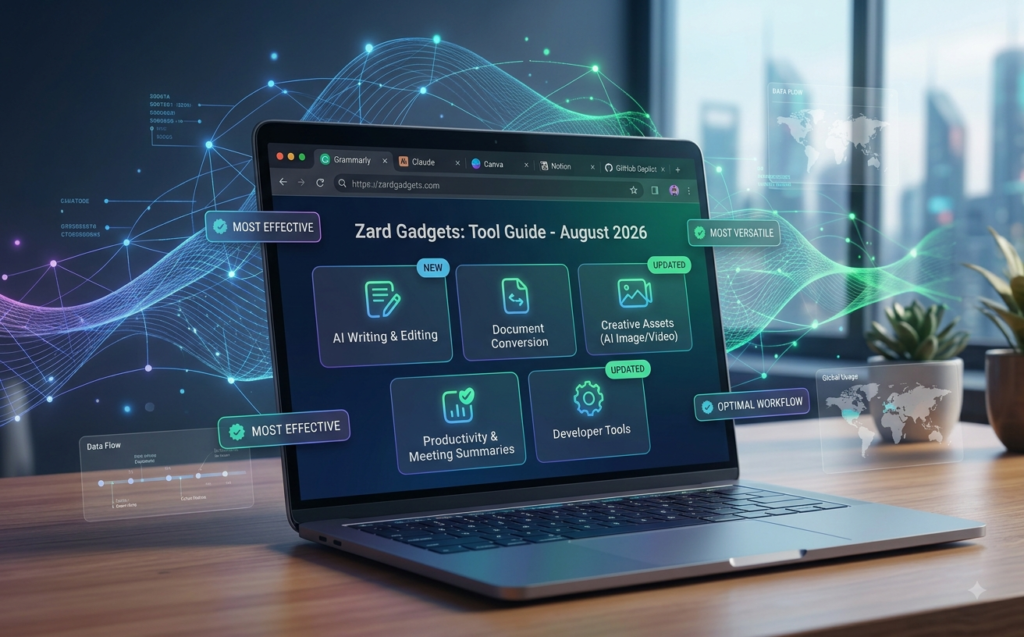
Take writing assistants. A year or two back, “AI writing tool” basically meant a grammar checker with a chatbot bolted on the side. That line’s gone now. Claude and ChatGPT can handle long documents and messy edits right in the browser. Grammarly still does its real-time tone checks without you leaving your inbox. Notion turned into this odd hybrid part notes app, part database, part AI assistant that drafts stuff for you while you’re still typing the outline. None of it needed an install. None of it looked like this a year ago either.
Categories Still Worth Your Attention
Some categories never really go out of style. They just quietly get better tools inside them.
Document and file conversion is still one of the most searched needs online makes sense- everyone hits a PDF that needs merging or converting sooner or later. What’s changed is speed. Batch jobs that used to choke on big files run fine now even on a shaky connection, and more tools are upfront about not keeping your files longer than the job takes.
AI image tools have moved way past simple background removal. Canva’s Magic Studio handles readable text in generated images now, plus batch resizing and editing in one pass stuff that used to need three separate apps open at once.
Meeting tools are having a moment too. Fathom and Otter both give you free transcription that summarizes calls and pulls out action items on their own. Anyone who’s sat through back-to-back client calls knows how much time that saves without you even noticing.
Developer tools leaned hard into AI pair-programming this year. Cursor and GitHub Copilot handle multi-file edits from a plain description now, not just line-by-line autocomplete. Handy even if you only touch code once in a while.
What Actually Makes a Tool Worth Trusting
A few things still separate a good tool from a waste of time. It should work without forcing a signup just to try the main feature. It should say clearly how long it keeps your uploaded files, especially anything sensitive. And it shouldn’t quietly shrink its free tier a month after you’ve gotten used to it.
That last one catches people off guard more than it should. A lot of “completely free” tools cap usage after a few uses a day, and the fine print is easy to miss when you’re in a hurry to get something done.
Building a Toolkit That Actually Sticks
Don’t try to adopt everything at once; that’s how half of it ends up unused. Pick one tool for writing, one for files, one for whatever repetitive task eats the most time in your week. Stick with just those for a couple of weeks before adding anything else. The toolkits that stick around aren’t the ones with the longest feature list. They’re the ones that quietly become the tab you open without thinking twice.
That’s really the whole idea behind any latest online tool guide zardgadjets roundup worth reading. Not a scramble to list everything that exists, but a filtered set that actually holds up under daily use.
Conclusion
The tools worth bookmarking in August 2026 aren’t the flashiest ones. They’re the ones that do what they promise, respect your time, and don’t vanish a few months after you start relying on them. A quick file conversion, an AI-assisted first draft, a meeting transcript that writes itself while you’re busy talking the best picks earn a permanent spot in your browser tabs. That’s the real test for any tool guide, latest label or not.